
Cummins UL2 is a liquid-only SCR dosing system whose injector is cooled by recirculating DEF. The supply unit is heated by engine coolant; the dosing unit is electrically heated. These are separate functions, and none should be inferred from the word “airless” alone. Cummins UL2 brochure, pp.2–3
This guide explains the documented UL2 architecture and the evidence needed before diagnosing a complaint or selecting a replacement. It does not assign a single UL2 assembly to every vehicle using the family name.
1. What are the main UL2 components?
Cummins describes a chassis-mounted supply unit and a dosing unit mounted at the decomposition reactor. The supply unit can include integrated dosing controls as an option. The dosing unit contains the injector, temperature sensing and pressure sensing, with a proprietary pressure-swirl atomizer. Cummins, p.2
The distinction matters when a workshop reports a “pump pressure sensor” fault. Identify the component and circuit named in the vehicle’s diagnostic procedure: the brochure places pressure sensing at the dosing unit. A generic description of an assembly is insufficient to determine the failed part or whether its subcomponents are separately serviceable.
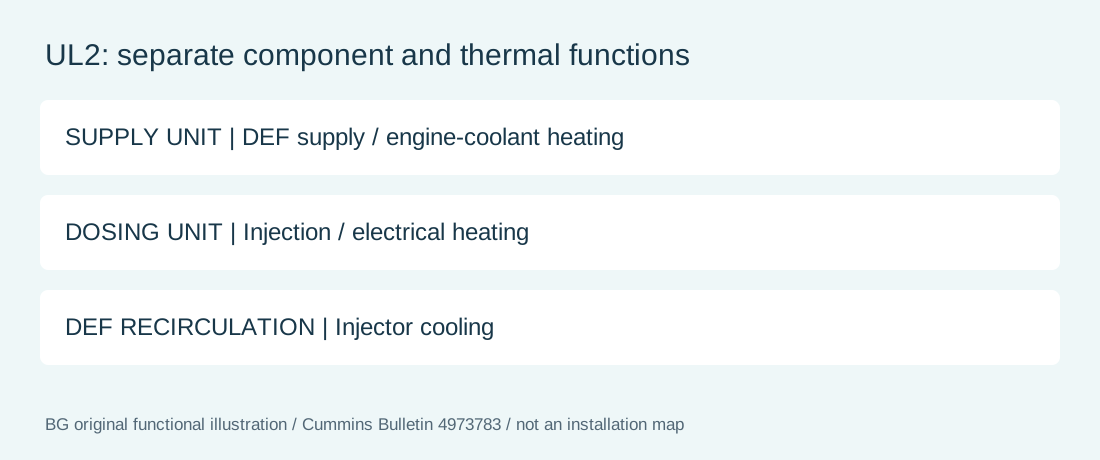
| Component | Documented function | Identification boundary |
|---|---|---|
| Supply unit | Supplies DEF; engine-coolant heating; optional integrated controls | Confirm installed reference and control configuration |
| Dosing unit | Injector with pressure and temperature sensing; electrical heating | Confirm exact assembly and electrical variant |
| DEF circulation | Provides injector cooling | Follow the application-specific routing and test procedure |
| Atomizer | Forms the spray using pressure-swirl technology | Spray specification depends on the documented variant |
2. How does DEF circulation cool the injector?
Cummins states that recirculating urea cools the injector instead of using engine coolant at the dosing unit. Its brochure describes removal of two injector coolant lines and addition of a urea line. This refers to the doser-cooling arrangement, not to removal of all coolant connections from the complete system: the supply unit still uses engine-coolant heating. Cummins, pp.2–3
For diagnosis, distinguish the liquid being discussed, its purpose and its destination. A report of a coolant-heating problem at the supply unit raises different questions from a suspected DEF-circulation problem at the dosing unit. The family brochure does not supply every vehicle’s hose identification, connector pinout or acceptance limits.
3. Does UL2 need a shutdown purge?
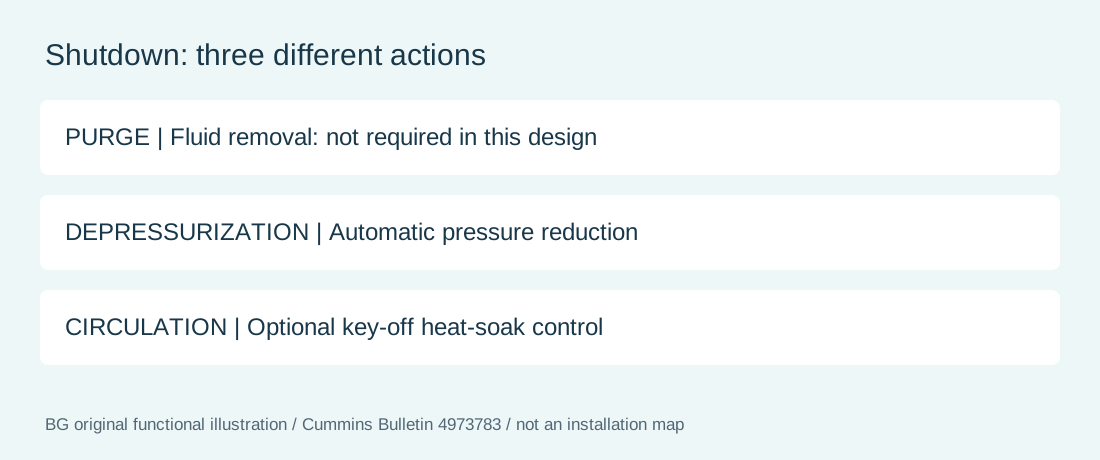
The brochure describes a non-purged design with retained urea, freeze-resistant components and automatic depressurization at system shutdown. It also describes optional urea circulation after key-off to counteract exhaust heat soak. Cummins, pp.3–5
These statements describe different actions. Purging removes fluid; depressurization reduces pressure; circulation moves fluid for a thermal purpose. Retained DEF therefore does not, by itself, prove a failed purge. Equally, “no purge required” does not establish that every electrical or hydraulic activity after key-off is abnormal.
Do not disconnect power or invent a waiting interval from this general description. Use the vehicle manufacturer’s shutdown, isolation and service procedure. Cummins’ freeze-robustness discussion and its optional heat-soak circulation should be read together, rather than turning one brochure statement into a universal workshop instruction.
4. What should a fault report contain?
The following is an evidence-gathering framework, not a claim about UL2 failure frequency or a replacement for an OEM test plan.
| Reported observation | Evidence to collect before selecting a part |
|---|---|
| No effective dose | Exact DTC, operating conditions, dosing request and measured delivery under the prescribed test |
| Abnormal pressure | Sensor identity, command state and pressure trace compared with the correct application limits |
| Suspected overheating | Identified DEF circulation path and relevant thermal measurements |
| Visible deposits | Location, leakage evidence, fluid condition and delivery/spray assessment |
| Cold-start complaint | Heater circuit identity and application-specific thawing checks |
| Key-off activity | Whether the event is depressurization or configured thermal circulation |
A pressure or delivery complaint alone does not identify a failed pump. Wiring, fluid paths, sensing and control conditions must be evaluated within the correct vehicle procedure. No universal pressure threshold, electrical resistance or dose quantity is prescribed here.
5. Why published specifications need their conditions
The original document is Cummins Bulletin 4973783, revision 2/21. Its specification table distinguishes dosing-rate variants and states test conditions for the table. It also distinguishes end-of-line accuracy from lifetime values. Cummins, p.5 and back cover
A brochure capability is not automatically a service-test target. Check the exact assembly, revision, voltage and OEM procedure before applying a number to a vehicle. This article deliberately does not convert brochure ratings into fault thresholds or claim that later UL2.2 hardware is interchangeable with UL2.
6. A real BG product reference—with its limits
BG lists BG203011 / OE A0001407678 as an independent aftermarket urea pump assembly for Actros/Arocs. The product page supplies a real catalogue reference and product photograph. It does not independently establish every UL2 variant’s interchangeability. View BG203011

Send the complete installed part number, label and connector photographs, vehicle/engine identity and supply voltage with an enquiry. Confirm the specific reference and any manufacturer supersession before ordering. A matching family name or similar housing is insufficient.
Quick answers
Is UL2 air-assisted? Cummins describes this UL2 architecture as liquid-only. Do not confuse injector cooling with compressed-air atomization.
Is the injector cooled by engine coolant? The documented UL2 doser uses DEF recirculation for cooling. Engine-coolant heating is assigned to the supply unit.
Does retained DEF prove a shutdown fault? No. The brochure explicitly describes retained fluid and no required purge. Judge pressure and thermal behaviour against the installed application’s procedure.
Can one UL2 pump fit every UL2 application? The system name does not resolve voltage, controls, connectors or vehicle-specific references. Confirm the installed assembly.
Sources and related reading
- Cummins: UL2 Urea Dosing System, Bulletin 4973783, Rev.2/21. Architecture pp.2–3; retained fluid and freeze robustness p.4; conditional specifications p.5; feature summary p.7. Primary technical source; source checked 2 November 2026 using the locally retained original PDF.
- BG203011 / A0001407678 catalogue page. Used only for the listed BG reference, application wording and product photograph; not adopted as an OEM system manual.
- Bosch Denoxtronic 2.2 system guide. Related architecture discussion; its procedures must not be transferred to UL2.