
With Denoxtronic 2.1, examining only the pump outlet leaves an important question unanswered: where does the returning DEF flow? The answer affects both system identification and the test procedure.
This second article focuses on Bosch's documented 2.1 architecture. It separates original-manufacturer descriptions, aftermarket application references and editorial diagnostic reasoning.
1. From air assistance to liquid-only dosing
Bosch places Denoxtronic 2.1 in 2006 and 2.2 in 2009. They are distinct systems. “Denoxtronic 2” in an aftermarket catalogue should not automatically be interpreted as 2.2. [7]
Unlike 1.1, 2.1 does not use compressed air for dosing. A supply module with integrated control feeds an electrically operated doser. Excess DEF cools the doser and returns to the tank. [1]
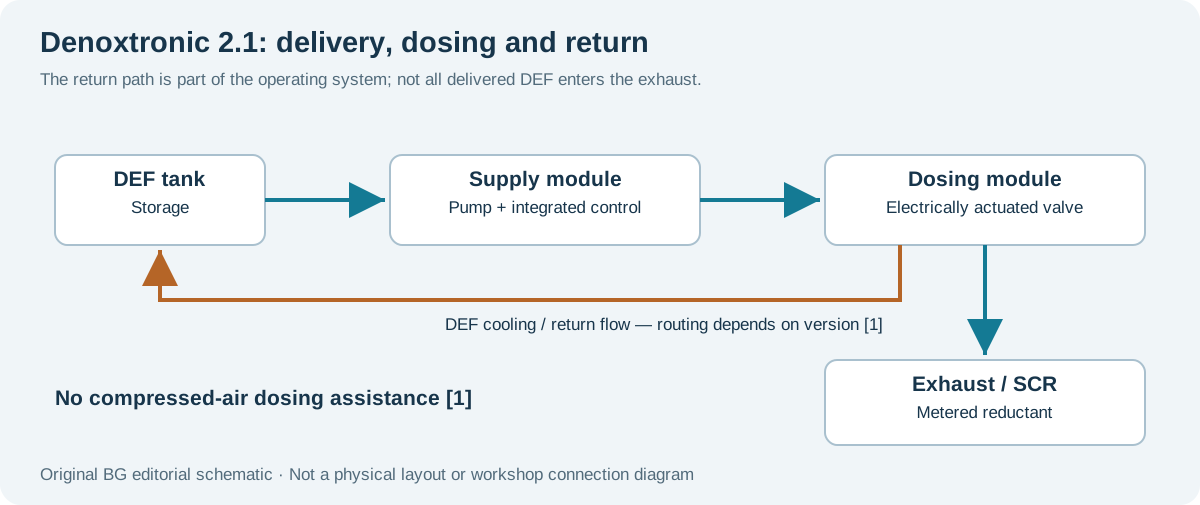
“Airless” describes dosing assistance. It does not mean the vehicle has no compressed-air system, and workshop leak-testing equipment should not be confused with an on-vehicle air-assisted doser.
2. Main components and published specifications
| Component | Documented role |
|---|---|
| Membrane pump | Develops supply pressure and delivers DEF. |
| Filter | Removes particles from the liquid. |
| 4/2-way valve | Changes the liquid-flow direction. |
| Integrated dosing control | Controls system functions, including doser cooling in the illustrated version. |
| Dosing module | Meters reductant into the exhaust; cooled through the DEF circuit. |
Bosch's catalogue lists 5.0 bar system pressure, 24 V operation and 9 kg/h maximum dosing for the illustrated 2.1 system. These are published catalogue characteristics, not universal workshop acceptance limits. Apply the procedure for the installed module and vehicle. [2]
Keep the supply module, dosing module and valve identifiers separate in an enquiry. A catalogue family, an OE number and a software version answer different questions; none should be silently substituted for another.
3. The cooling-return circuit has three arrangements
Bosch documents three configurations: CCV, with an electrically controlled cooling valve in the supply module; CCA, with a fixed restrictor in the doser and return via an adapter in the supply module; and direct return, with a fixed restrictor and return straight to the tank. The first two have four DEF connections at the supply module; the last has two. Confirm the version through identification, not port count alone. [1]
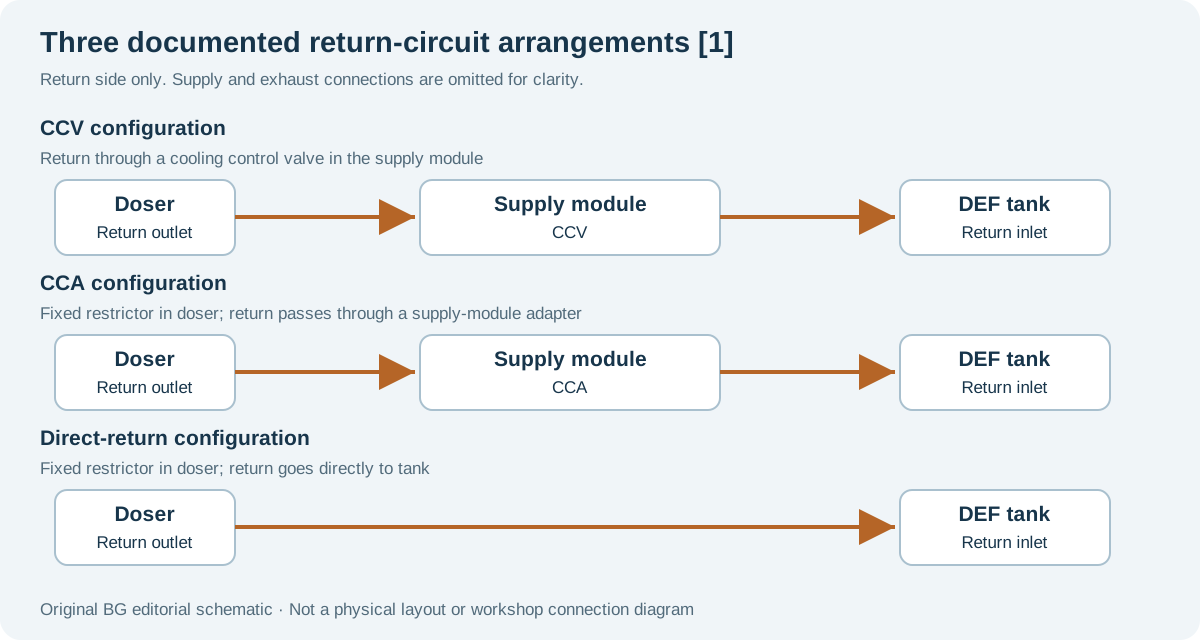
The practical implication is that a hose or test connection that makes sense on one arrangement may be wrong for another. Photograph the pipe routing before removal, and record the component identification before choosing adapters.
4. Application coverage: what can be substantiated?
Bosch's 2.1 filter-service table lists Case, IVECO, KHD, Renault and Volvo. It supports manufacturer-level application, not an all-model or all-year fitment claim. [2]
| Aftermarket catalogue entry | OE examples | Evidence limit |
|---|---|---|
| Volvo / Renault — “Denoxtronic 2”, Euro V | 20908711; 20975638; 21161861 | Catalogue family; verify the exact module. |
| IVECO — “Denoxtronic 2” | 504365261; 500059692; 500061238 | Catalogue reference, not a universal replacement list. |
These entries come from rema.germany's catalogue. Its individual IVECO listing connects these OE references with Bosch 0444022001 / 0444022019 and includes a control-unit reprogramming note. Confirm any required programming against the actual vehicle. [4] [5]
Do not order by “Volvo Euro V” or “IVECO SCR pump” alone. The catalogue also lists other system families under the same brands. An accurate enquiry should include VIN, engine, emission level, the complete old-part number and connector/port photographs. See BG's OE-identification guide.
5. Typical complaints: useful distinctions before replacing parts
The following are diagnostic questions, not a ranked list of known failure rates. Possible causes require confirmation by testing.
| Complaint | Question to resolve |
|---|---|
| No dose / low DEF consumption | Is dosing commanded and enabled? What do the supply and doser function tests show? |
| Pressure will not build or remain stable | Do measured pressure, suction and valve response agree? Is a restriction or leak indicated? |
| Pressure looks plausible but quantity is wrong | What quantity is actually collected under the prescribed conditions? Do not treat pressure as proof of metering accuracy. |
| Unexpected return behaviour | Was the CCV/CCA/direct-return version correctly identified and the matching test setup used? |
| Deposits or apparent leakage | Where is the source? Does inspection or leak testing support a component fault? |
| Electrical or communication complaint | Does the specific code concern supply voltage, wiring, an actuator or communication? Check its definition before condemning a module. |
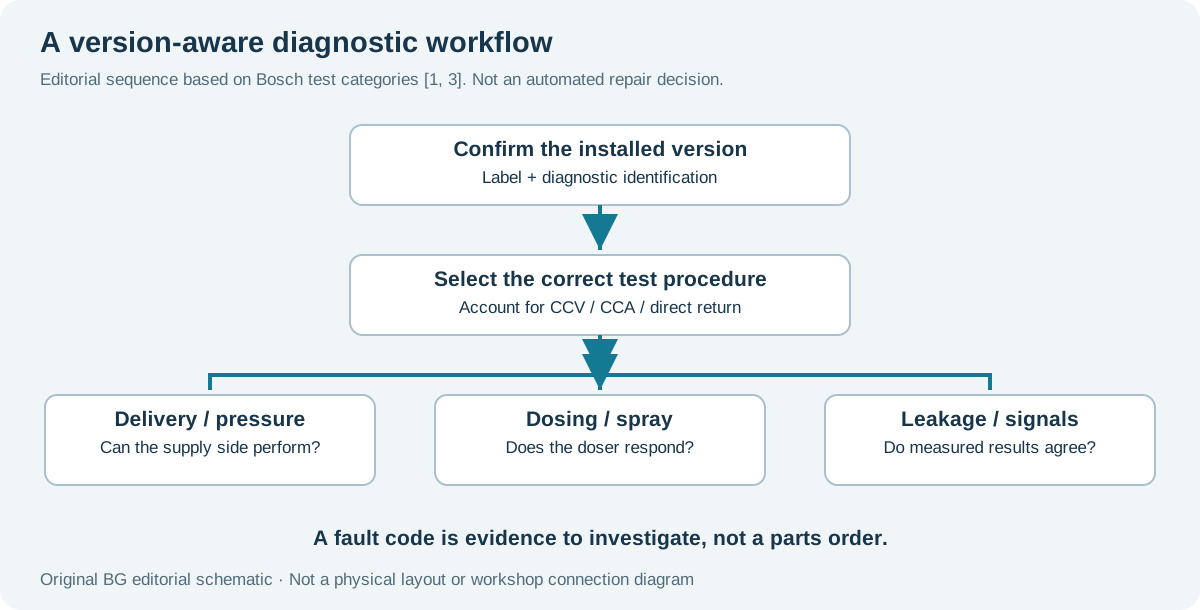
Bosch's 2.1 test-equipment instructions describe module self-diagnosis, actuator/function tests, a dedicated pressure gauge for pressure/switchover/suction checks, and measurement of return and dosing quantities. Controlled test conditions are essential; follow the specified adapter and sensor-value setup. [3]
A motor sound, a pressure reading and a collected dose are different observations. Record which one was actually measured. A result from one test should not be presented as proof that the entire SCR system is healthy.
6. Parts support and repair verification
Use BG's DEF / urea pump catalogue or DEF pump repair-parts range as enquiry entry points. These category links do not establish 2.1 compatibility for every listed item. Send the OE number and identification photographs to BG for reference-specific confirmation.
After a repair, choose the applicable verification routine and document its result. Bosch lists dedicated 2.1 repair/test tools; an adapted lead alone is not evidence that a bench device supports the required module and routine. [6]
References
- Bosch, Denoxtronic Set 2, 0 986 629 470; English section 1.5, 1.5.1–1.5.2 and 10 (PDF pp.29–33, 40–45).
- Bosch, Denoxtronic diagnosis, replacement and service for the workshop; printed pp.10, 13, 18: specifications, filter applications and 2.1 components.
- Bosch, Denoxtronic 2.1 product description, 1 689 989 404, 1 March 2019; English printed pp.19–24: test equipment, adapter, pressure and quantity checks.
- rema.germany, AdBlue Supply Units, p.2: catalogue families and OE examples. Aftermarket reference, not original-vehicle fitment approval.
- rema.germany, delivery module 848081: IVECO OE references, Bosch numbers and programming note.
- Bosch, repair tools: Denoxtronic 2.1 pressure gauge and test adapter.
- Bosch, Denoxtronic truck-system timeline: 2.1 introduced in 2006, 2.2 in 2009.
Illustrations are original functional schematics based on the cited descriptions. Sources 4 and 5 are aftermarket manufacturer references, not vehicle-OEM approvals. Diagnostic questions are editorial reasoning from the documented test functions. This article does not provide vehicle-specific pressure tolerances, pinouts or a substitute for repair instructions.