
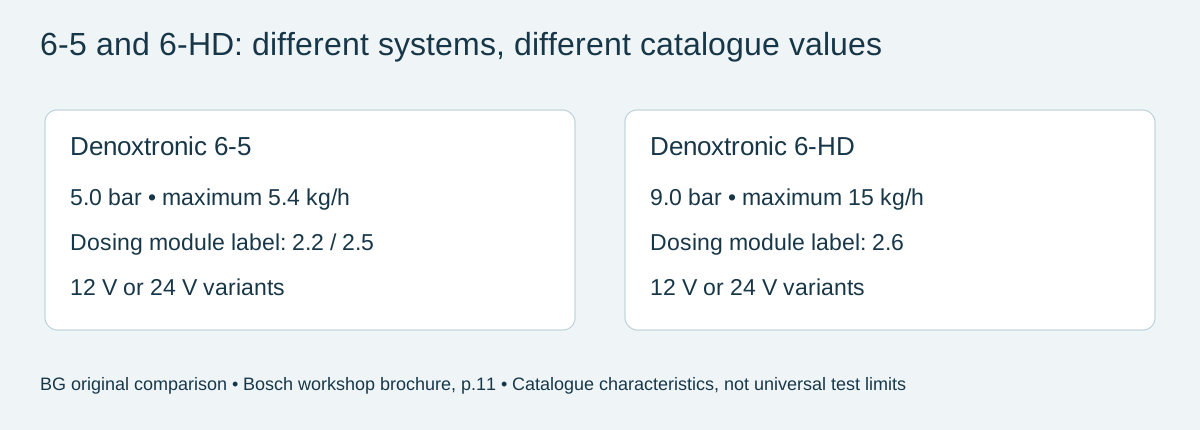
Denoxtronic 6-HD is a Bosch dosing platform distinct from 6-5 and 2.2. Bosch's workshop catalogue lists 9.0 bar, 12 V or 24 V variants, maximum dosage of 15 kg/h and dosing module 2.6. These are catalogue characteristics, not a universal bench-test specification. Bosch workshop brochure, p.11
The practical issue is identification. “Heavy-duty Bosch pump” does not uniquely identify 6-HD, and a reference to “2.6” may identify a dosing module rather than an entire dosing system. A supplier needs both pieces of information when checking an enquiry.
Read the component labels separately
The same table places the controller outside the supply module, identifies coolant cooling for the doser, and allows electrical or coolant heating for the 6-HD supply module. Its filter-service table lists MAN, John Deere, IVECO and CNH. These manufacturer names do not establish a complete model-year application list. Bosch workshop brochure, pp.11,13
For an enquiry, record the installed pump, doser and controller identities separately. A photograph showing a coolant connection supports a description of the hardware; it cannot establish which calibration or replacement reference applies.
Why newer public specifications need care
Bosch's current commercial-vehicle supply-module page discusses a design offering up to 18 kg/h, without identifying that headline as the same catalogue 6-HD version above. It also describes a concept without return to tank and without a requirement to drain for freezing conditions. Do not silently transfer those features to every older Denoxtronic system. Bosch commercial-vehicle supply module
This is a source-matching problem, not a reason to choose whichever number appears newest. Product generation, component variant and document scope must match. A general technology page and a service catalogue may describe different hardware, even when both use the Denoxtronic name.
A useful comparison record
| Record | Why it belongs in the enquiry |
|---|---|
| Full old-part number and suffix | Distinguishes a reference from a family nickname |
| Rated voltage | Confirms the electrical version |
| Vehicle/equipment and engine identity | Establishes the application being checked |
| Supply-module heating arrangement | Prevents confusing installation variants |
| Dosing-module identity | Prevents a pump reference becoming a doser order |
| Exact fault and test evidence | Separates a sourcing request from a repair hypothesis |
Interpreting common complaints
If pressure is inadequate, document the specified test and the actual result before assigning a cause. If pressure is plausible but quantity is incorrect, record a quantity assessment rather than declaring the entire system healthy. If a leak is reported, identify the fluid and component first. These are diagnostic reasoning steps; the correct procedure and tolerances must come from the installed vehicle's service information.
After repair, compare like-for-like results under the applicable conditions. A different test stage or sensor location can make a numerical comparison misleading even when the units are the same.
BG parts support
Search the BG product directory or DEF pump range, then request reference-specific confirmation through BG Contact. The links do not establish 6-HD compatibility for every listed product.
Can a 9 bar 2.2 pump replace a 9 bar 6-HD pump? A shared pressure value is insufficient evidence. Match the complete reference, configuration and approved application; do not use catalogue pressure as a replacement rule.