
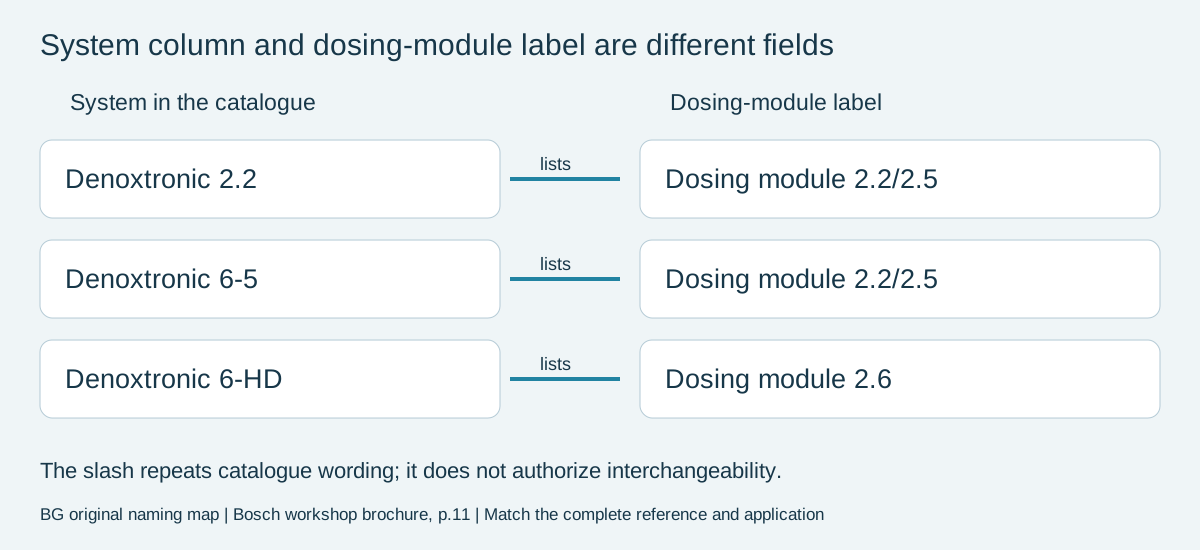
Denoxtronic system families, dosing-module labels and complete part numbers are different identifiers. Bosch's workshop brochure lists Denoxtronic 2.2 and 6-5 alongside dosing modules labelled 2.2/2.5, and 6-HD alongside dosing module 2.6. A number such as “2.5” therefore needs context before it becomes a system classification or an order. Bosch workshop brochure, p.11
This guide helps parts buyers and workshops interpret names. It is a naming and identification reference, not a replacement approval, an exhaustive list of every Bosch variant, or a version-specific repair manual.
1. Start with the layer, not the number
“Denoxtronic 2.2” can identify a system family. “Dosing module 2.2” identifies a component family in the cited table. The shared digits do not make those descriptions equivalent. Likewise, an installed supply module, exhaust-mounted doser and controller are separate items in an enquiry.
| Identifier | What it helps describe | What it does not establish |
|---|---|---|
| Bosch | Supplier identity | The installed dosing family |
| Denoxtronic 2.2, 6-5 or 6-HD | System-family context | One universal replacement part |
| Dosing module 2.2/2.5 or 2.6 | A component label in the cited catalogue | The complete vehicle installation |
| Full Bosch/OE reference and suffix | A specific reference to investigate | Compatibility without an application check |
Keep these fields separate in a stock list. A family name is useful for finding the relevant article; the complete reference is needed to investigate the particular component.
2. Read the documented system branches separately
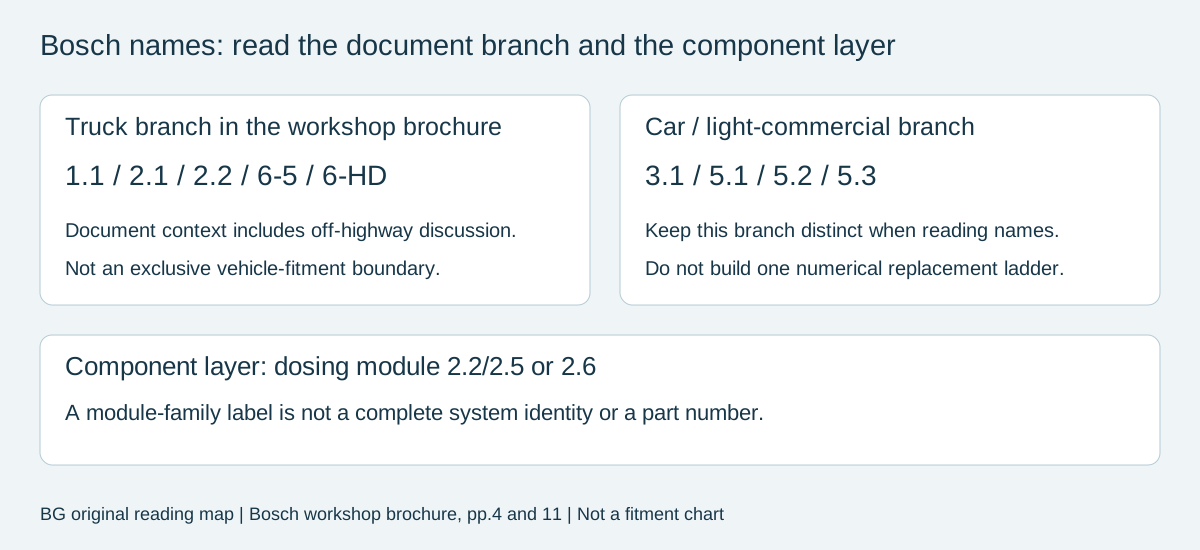
The brochure's truck branch shows 1.1, 2.1, 2.2, 6-5 and 6-HD. Its car/light-commercial branch shows 3.1, 5.1/5.2 and 5.3. Bosch workshop brochure, p.4
That presentation does not justify sorting every name into one ascending ladder. Nor does a branch heading mean a system can only ever appear in that vehicle category: Bosch's IAA 2018 text also discusses 6-5 for light commercial vehicles. Read the document's scope alongside the name. Bosch IAA 2018 release, exhaust-treatment section
For a Sprinter, Transit, truck or off-highway machine, retain the market, engine and vehicle/equipment identity. A model badge or emission stage alone does not support assigning one Denoxtronic family across all years and markets. This guide supplies no guessed model-year matrix.
3. Why “Bosch 2.5” and “Bosch 2.6” need clarification
| System column in Bosch's brochure | Dosing-module label in that column |
|---|---|
| Denoxtronic 2.2 | Dosing module 2.2/2.5 |
| Denoxtronic 6-5 | Dosing module 2.2/2.5 |
| Denoxtronic 6-HD | Dosing module 2.6 |
Source: Bosch workshop brochure, p.11. The slash is reproduced from the catalogue; it is not an interchangeability instruction.
If an enquiry says “Bosch 2.5 pump,” first establish whether the customer means a pump or an exhaust doser. Record the wording exactly and request the complete label. Do not silently turn a component nickname into an independently verified pump generation.
Similarly, “6.5 injector” does not fully identify a doser. Preserve the system context and the doser's own reference. Confirm the component being ordered before comparing quotations.
4. What the 2.2 evo name establishes
Bosch's IAA 2018 release explicitly identifies Denoxtronic 2.2 evo as a flexibly configurable dosing system. The suffix is documented; it should not simply be discarded when it appears in relevant identification material. Bosch IAA 2018 release, exhaust-treatment section
That announcement is not a universal parts-supersession bulletin or a workshop conversion procedure. It does not establish that a seller's “2.2 evo” listing has one particular pressure, wiring layout or vehicle application. Obtain the actual hardware reference and application documentation before making those claims.
This article does not reconstruct undocumented evo sub-variants or transfer specifications from another Denoxtronic platform. A repair article needs evidence for the exact version being repaired.
5. Cooling language is a separate identification field
Bosch's current dosing-module page distinguishes water-cooled and air-cooled variants. That is a statement about thermal management. Bosch Denoxtronic dosing module, operating principle
“Air-cooled” alone is not evidence of a compressed-air supply for DEF atomization. Record cooling, supply heating and dosing assistance separately. Otherwise a cooling description can become an unsupported air-line diagram or test instruction.
6. Turn an ambiguous name into a useful BG enquiry
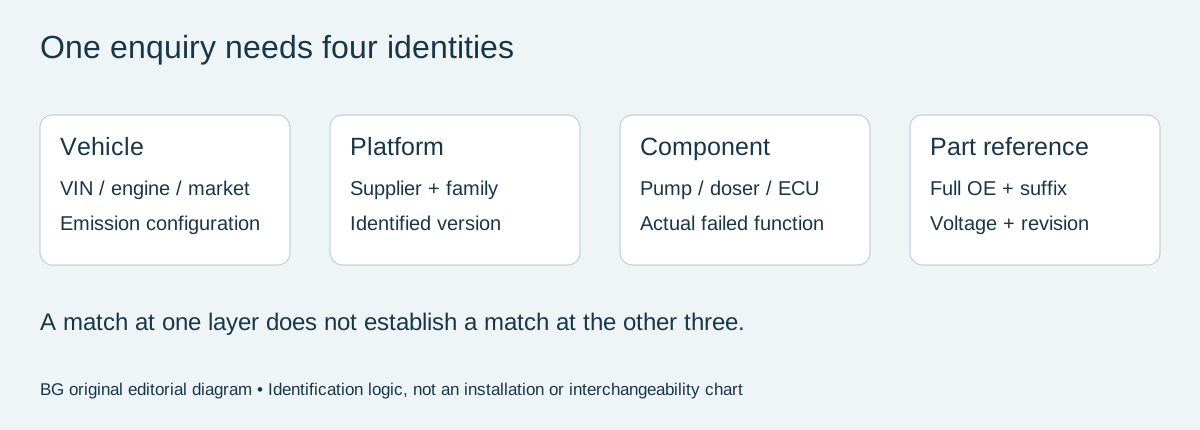
Send the complete old-part reference, a readable label photograph, the component's role, and the vehicle/equipment and engine identity. Include the market, rated voltage and relevant revision information when available. Do not abbreviate away a suffix that may distinguish variants.
A useful request reads: “Please identify this exhaust-mounted dosing module from its attached label and application details.” It is more actionable than “Send a Bosch Euro VI pump.” This is an editorial communication example, not an invented customer case.
Browse BG DEF / Urea Pumps, search the BG part-number directory, or request identification from BG. These are catalogue and enquiry links; none is presented as universal compatibility approval for the names in this guide.
Quick answers
Is Denoxtronic 2.5 the same thing as Denoxtronic 2.2? The brochure's “2.2/2.5” wording is a dosing-module label. Establish the naming layer and full reference before making an equivalence claim.
Does “2.2 evo” prove that a standard 2.2 part can be upgraded? No. The cited announcement documents a system name, not a universal conversion approval.
Are 5.1, 5.2 and 5.3 simply the next heavy-truck systems? Do not classify them that way from their numbers. The cited timeline places them in its car/light-commercial branch; an individual application still requires original reference checks.
Continue the series
For platform-specific explanations, read Denoxtronic 1/1.1, 2/2.1, 2.2, 6-5 and 6-HD. The SCR classification hub places Bosch alongside other supplier groups.
Sources and scope
- Bosch, Denoxtronic diagnosis, replacement and service for the workshop, printed p.4 (system branches) and p.11 (system/supply/dosing-module columns). These pages support naming, not a worldwide fitment database.
- Bosch Media Service, IAA 2018 commercial-vehicle innovations, German original, “Abgasnachbehandlung” section: 2.2 evo and application context. The historical event date is separate from the current webpage's corporate footer.
- Bosch Mobility, Denoxtronic dosing module, operating-principle section: cooling terminology. Current product-page statements are not silently applied to every historical module.
Prepared by Best Growth (BG). Original explanatory text and editorial diagrams; no claim of Bosch affiliation, human expert review, complete variant coverage or application-specific repair approval.