
Diesel exhaust fluid (DEF), also marketed as AdBlue, is the reductant discussed here. A request for a “Denoxtronic 2.2 pump” still leaves several questions open. Which OE reference, voltage and heating configuration are fitted? Is the reported fault in delivery, metering or system control? This guide connects the system layout with the evidence needed for a sound parts enquiry or workshop diagnosis.
1. How Denoxtronic 2.2 works
The supply module feeds DEF to the doser upstream of the SCR catalyst. Ammonia formed from the reductant participates in NOx conversion to nitrogen and water. In the standalone control arrangement, a dosing controller communicates with the engine ECU over CAN; the alternative incorporates system control in the engine ECU. [1]
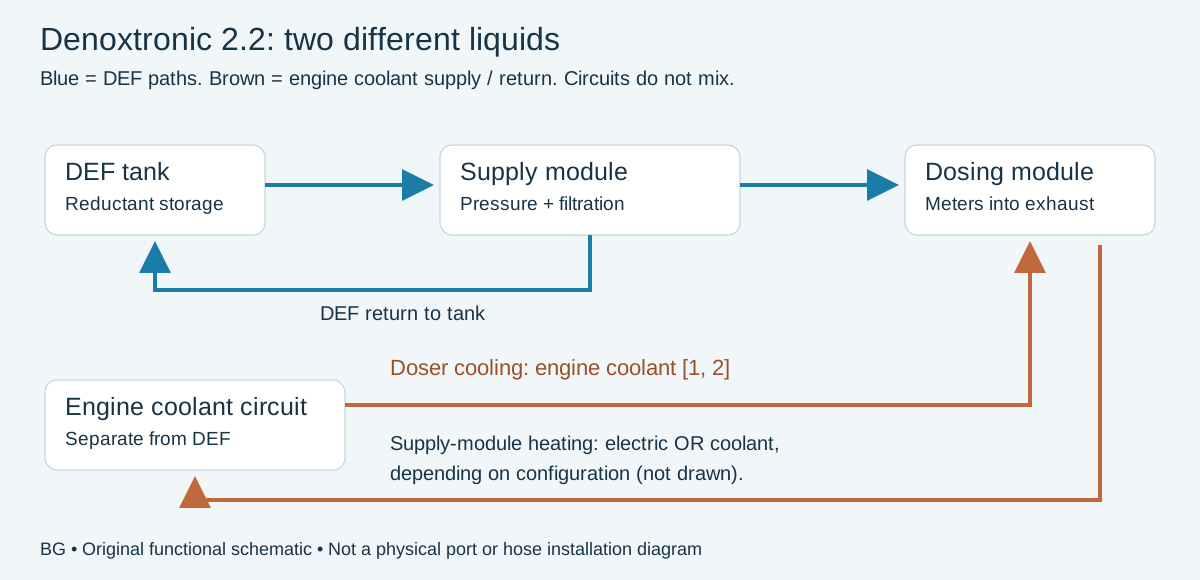
This distinction matters when describing a leak. “Fluid near the doser” is incomplete evidence: identify the liquid and the affected connection. A coolant-circuit complaint and a DEF delivery complaint lead to different checks. Photograph both circuits before removal, and use the installed version’s connection diagram.
2. Main components and catalogue specifications
Bosch describes a supply module with a replaceable DEF filter and a dosing module whose spray is matched to the exhaust-treatment concept. Its system illustration also distinguishes the dosing controller/engine ECU, exhaust sensors, mixer and SCR catalyst. These related components should not all be described as part of the “urea pump.” [3]
| Item | Role or published characteristic | Practical implication |
|---|---|---|
| Supply module | Pressurizes and feeds DEF; DCU not integrated. | Identify the pump and controller separately. |
| Dosing module | Meters reductant; cooled by engine coolant. | Keep DEF and coolant connections distinct. |
| Published system pressure | 9.0 bar | A catalogue value, not a universal pass/fail threshold. |
| Operating voltage | 12 V or 24 V | The family includes different electrical versions. |
| Maximum dosage | 12 kg/h | A listed maximum, not a constant operating demand. |
| Supply-module heating | Electric or engine-coolant circuit | Confirm the actual configuration before ordering. |
These are Bosch’s published 2.2 catalogue characteristics. Vehicle-specific test conditions and acceptance limits take precedence during diagnosis. Bosch also places the filter replacement interval under the vehicle manufacturer’s maintenance schedule. [2]
3. Denoxtronic 2.1 versus 2.2
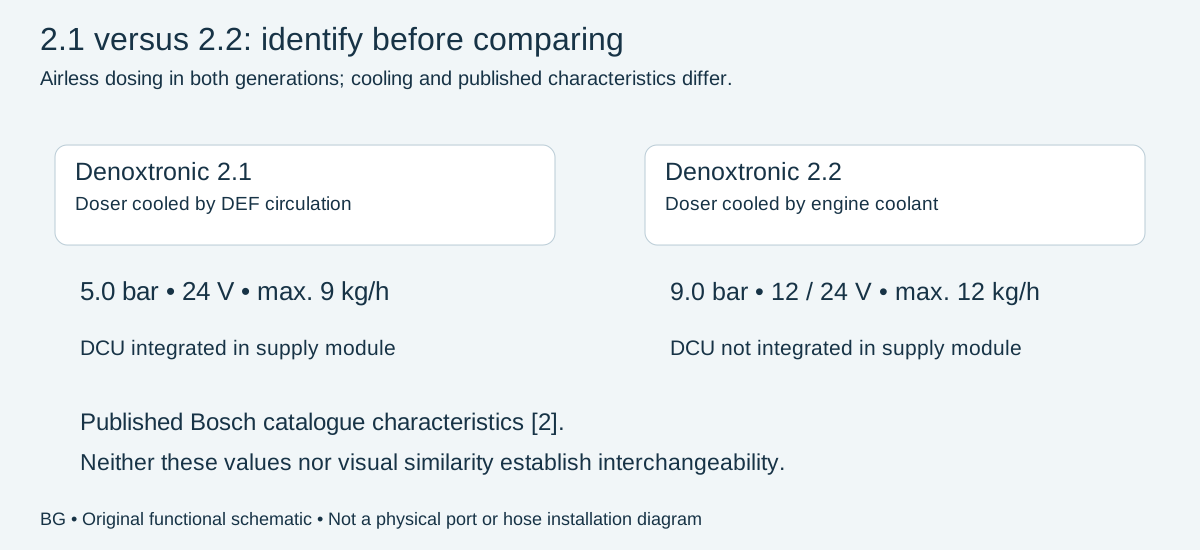
Control integration needs careful wording. “Control integrated in the engine ECU” does not mean “DCU inside the supply module.” Those statements refer to different physical locations. A replacement enquiry should name the component being replaced rather than describing every electronic fault as a pump failure.
For the earlier liquid-cooling return arrangements, read Part 2: Bosch Denoxtronic 2 / 2.1. The series begins with Part 1: Denoxtronic 1 / 1.1.
4. Vehicle applications and BG product references
The following examples combine two kinds of evidence: rema.germany’s catalogue associates the OE references with the Denoxtronic 2.2 family; the linked BG pages provide product and model descriptions. This is an aftermarket catalogue cross-check, not original-vehicle fitment approval. [4]
| Application example | OE reference | BG catalogue entry |
|---|---|---|
| DAF CF / XF 106 — catalogue example | 1819797 | BG203032 DEF pump |
| IVECO Stralis — catalogue example | 504381868 | BG203240 DEF pump |
| Volvo FH / FM — catalogue example | 22851845 | BG203209 DEF pump |

Do not generalize these entries to every DAF, Stralis or Volvo truck. For a replacement request, provide the VIN, engine identification, full OE and Bosch numbers on the old unit, rated voltage, connector photographs and hose-port photographs. Ask the supplier to confirm the offered reference and any configuration or programming requirements against those identifiers.
For other references, browse BG’s DEF pump range or send BG an identification enquiry. A category listing alone does not confirm compatibility.
5. Common fault complaints: what the evidence must establish
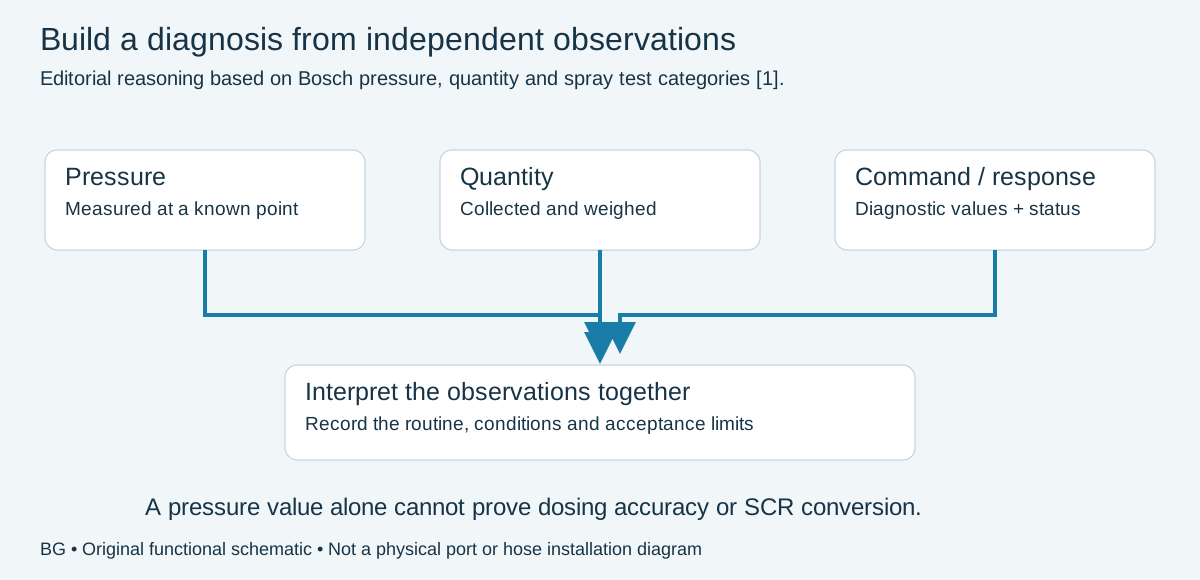
These are complaint categories and diagnostic questions, not measured failure frequencies. Bosch’s procedure combines code reading, pressure/leak checks, collected dosing quantity and spray assessment; it compares the supply-module pressure signal with a mechanical gauge and considers pump duty. Quantity is weighed under prescribed conditions. [1]
| Complaint | Question to resolve | Evidence to record |
|---|---|---|
| Pressure does not build | Where is delivery being lost: supply, restriction, leakage or actuation? | Routine conditions, measured pressure, reported pressure and observed response. |
| Pressure appears normal, dose is wrong | Was the commanded quantity actually delivered? | Collected mass and applicable tolerance; a plausible pressure value alone is insufficient. |
| Pressure signal looks implausible | Do independent measurements disagree consistently? | Gauge location, diagnostic value and test stage before attributing the issue to a sensor. |
| Deposits or wet connections | Where does the material originate, and is leakage active? | Liquid identification, location and the relevant leak-test result. |
| Cold-weather / heating complaint | Which heating configuration is actually fitted? | Installed hardware, related codes and vehicle-specific heating test results. |
| Electrical / communication fault | Which circuit or module does the code identify? | Exact code definition, power supply and connection checks from the applicable procedure. |
| NOx-related warning remains | Has only delivery been checked, or has the vehicle’s complete SCR diagnostic path been followed? | Dosing results together with the relevant exhaust-system diagnostic findings. |
The table is an editorial decision aid. It deliberately separates an observation from its suspected cause. “The pump runs,” “pressure reaches a value” and “the correct dose is delivered” are different findings. Record them separately so that the next repair decision can be checked against the evidence.
6. Practical questions
Does Denoxtronic 2.2 use compressed air for dosing?
No. It is an airless dosing system. Do not confuse a vehicle’s general compressed-air equipment with the reductant-dosing method. [1]
Is 9 bar enough to declare the system healthy?
No. It is the published catalogue pressure, while a diagnosis also needs the correct routine and an assessment of delivered quantity. Use the actual vehicle’s limits rather than turning a headline specification into a universal repair rule. [1] [2]
Can two pumps be exchanged because both are called 2.2?
The family name is insufficient. Obtain reference-specific confirmation for voltage, connectors, plumbing and configuration. Similar appearance is useful for documenting a part; it is not proof of interchangeability.
What should accompany a fault-related parts enquiry?
Include the full part identification and the actual test result: for example, the pressure routine used, the measured value and the collected dose. An exact result is more useful than a request stating only “SCR pump fault.”
Sources and scope
- Bosch, Denoxtronic-Set 2, 0 986 610 450; English sections 7–8 and 10, PDF pp.32–33 and 39–43: architecture and diagnostic methods.
- Bosch, Denoxtronic diagnosis, replacement and service for the workshop; printed pp.10–13: components, catalogue specifications and filter applications.
- Robert Bosch LLC, Denoxtronic 2.2 — Heavy Commercial & Off-Highway Vehicle Exhaust Gas Treatment, document 22092606, ©2022; distributor-hosted Bosch publication, pp.1–2.
- rema.germany, AdBlue Supply Units, p.2: Denoxtronic 2.2 catalogue families and OE references. An aftermarket manufacturer catalogue, not vehicle-OEM fitment approval.
- BG public product pages for BG203032, BG203240 and BG203209; accessed 19 October 2026. Used for BG catalogue descriptions and the identified product photograph.
System facts and catalogue values are attributed above. Application examples are limited to the cited aftermarket references. Diagnostic questions and enquiry guidance are BG editorial synthesis, not vehicle-specific repair instructions. No failure-rate dataset or universal model-year fitment list is asserted.