
Bosch Denoxtronic 6-5, often written as 6.5 in the aftermarket, is a DEF dosing platform. Its published design uses a diaphragm supply pump and a separately cooled dosing module. Identifying it requires both the system family and the installed part numbers. Bosch 6-5 product sheet, pp.1–2
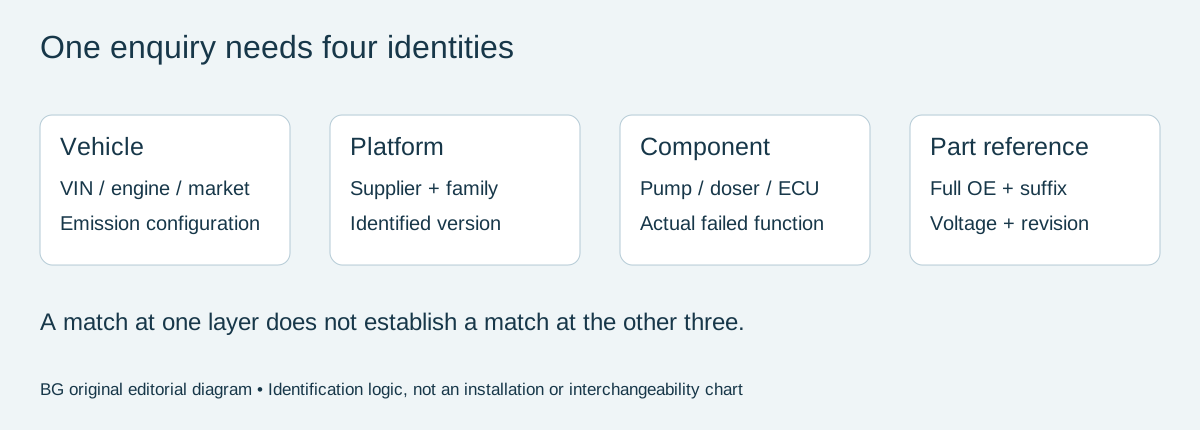
The question “Is this a Bosch 6.5 pump?” should begin an identification process, not end it. A complete enquiry distinguishes the supply module, the exhaust-mounted doser and the controller. Each has its own reference and function. Replacing one does not automatically resolve a fault attributed to another.
1. How the documented system works
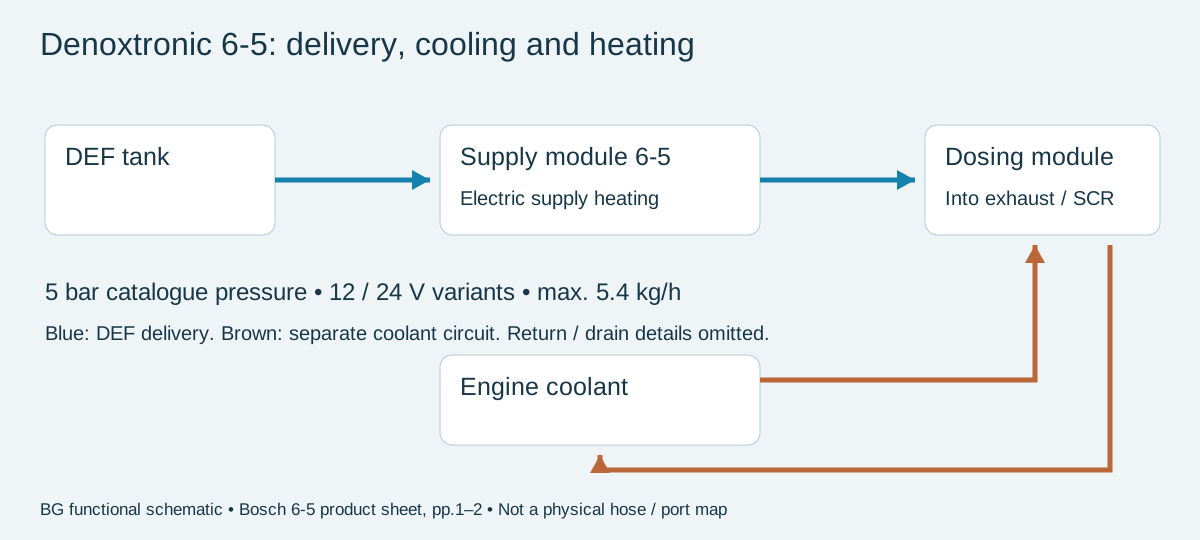
The supply module draws DEF from the tank and establishes pressure; pump speed regulates that pressure. The doser meters fluid into the exhaust upstream of SCR and is actively cooled by engine coolant. Control can reside in the engine ECU or a separate dosing controller. Bosch's described shutdown strategy includes draining, with heating supporting subsequent cold operation. These are design descriptions, not permission to improvise a drain or heating test. Bosch product sheet, p.2
2. Published characteristics
| Characteristic | Bosch product-sheet value | How to interpret it |
|---|---|---|
| System pressure | 5 bar | Not a universal workshop tolerance |
| Dosing range | 45–5,400 g/h | Listed platform range, not every operating point |
| Electrical variants | 12 V or 24 V | Confirm the particular unit |
| Supply-module heating | Electric | Separate from doser coolant cooling |
Source: Bosch 6-5 technical characteristics, p.2.
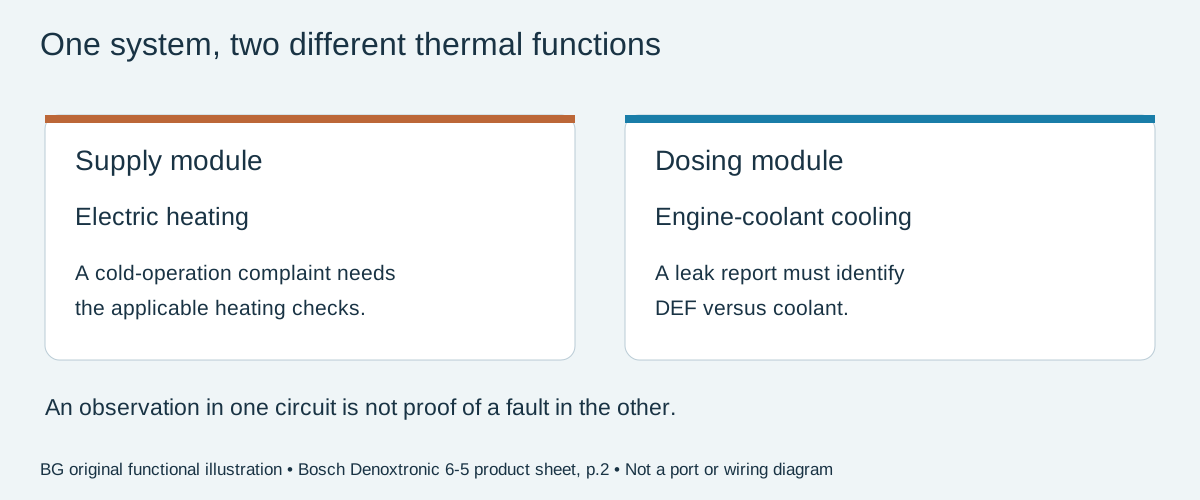
A useful service distinction is therefore supply heating versus doser cooling. A complaint involving one function should not be described as proof that the other is faulty. Record the affected circuit and the conditions under which the complaint occurs.
3. Applications: manufacturer coverage is not model approval
Bosch's filter-service catalogue lists Perkins, IVECO, CNH, JCB, Daimler India and CAMC for the 6.5 service kit. That is manufacturer-level service coverage, not confirmation that every engine or truck sold by those manufacturers uses the same module. Bosch workshop brochure, p.13
Do not infer a particular BharatBenz, IVECO or construction-machine model from the manufacturer name alone. Ask for the VIN or equipment serial number, engine identification and full supply-module and doser references. A machine serial number can be as important as a road-vehicle VIN when variants change within a product family.
4. Fault complaints and the evidence to request
The following is an editorial enquiry guide, not a ranking of component failure rates.
| Complaint | Evidence that makes the report useful |
|---|---|
| Failure to build pressure | Exact test routine, conditions, reported pressure and any independent measurement |
| Apparently normal pressure but incorrect dosing | Actual collected quantity and the applicable acceptance limits |
| Complaint after shutdown | Event timing, installed control strategy and relevant diagnostic information |
| Cold-operation complaint | Installed heating version and the vehicle-specific heating-test result |
| Leak near the doser | Identify whether it is DEF or coolant, and the precise connection |
A pressure value and an accurately delivered quantity answer different questions. Keep both in the repair record. After a component change, repeat the applicable verification instead of treating disappearance of a warning as the only evidence of repair.
5. BG parts support
Use BG's DEF pump catalogue and part-number directory to start an enquiry. No specific BG reference in this article is asserted to fit all 6-5 installations. Send the full old-part numbers and photographs through BG Contact.
For the earlier platform, see Denoxtronic 2.2. Its specifications should not be substituted for the 6-5 data above.
6. Practical question
Does a matching 5 bar specification prove interchangeability? No. It leaves electrical interfaces, mounting, heating, control and calibration unresolved. A correct replacement needs an application-specific reference match.
Scope: original explanation and editorial diagnostic questions; no universal pinout, failure-frequency dataset or vehicle-specific repair limits are supplied.
Sources and link scope
- Bosch, Denoxtronic 6-5 product sheet (Chinese), 2018 microsite, pp.1–2: system architecture, thermal functions, published characteristics and shutdown strategy.
- Bosch, Denoxtronic diagnosis, replacement and service for the workshop, printed pp.11 and 13: 6-5 component overview and manufacturer-level filter-service coverage.
- BG public catalogue, part-number directory and Contact pages, checked 24 October 2026. These links are catalogue / enquiry entry points; no exact BG-to-6-5 replacement reference has been established in this article.