
An SCR parts classification works best when it separates the supplier, dosing platform, component and reductant. “Bosch,” “UL2,” “urea pump” and “AdBlue” are useful terms, but they do not name the same kind of thing.
This reference guide is intended to help readers choose the right technical article and prepare an enquiry. It is not a global vehicle-fitment database or a market-share ranking.
Start with the product layer
Bosch describes a modular dosing system with supply, dosing and control functions. Its system explanation identifies the reductant as a 32.5% aqueous urea solution, converted to ammonia for SCR reactions. Bosch Denoxtronic system
| Term in an enquiry | What should be clarified |
|---|---|
| Complete SCR system | Is the request for the whole aftertreatment installation? |
| Supply module / pump | Which complete component reference? |
| Dosing module / nozzle | Which architecture and exhaust location? |
| Controller | Which hardware and installed configuration? |
| DEF / AdBlue / ARLA | Is the customer naming the reductant rather than a pump platform? |
Cummins' UL4 brochure uses DEF, AdBlue and Brazil's ARLA terminology for the reductant. “ARLA” should therefore not be inserted as though it were another supplier's dosing-system generation. Cummins UL4 brochure, p.4
A reading map rather than a universal fitment table
| Product/supplier group | Article focus |
|---|---|
| Bosch Denoxtronic | Distinguish system names from dosing-module labels and vehicle-specific references |
| Hilite / Cummins EcoFit UL | Separate corporate history, liquid-only architecture and actual hardware |
| Cummins UA2 | Air assistance and its diagnostic implications |
| Albonair | Separate traditional air assistance, CDS, dual/heated options and StationAir |
| Historical EMITEC labels | UDS/UDA catalogue identification and evidence limits |
| DINEX | Assembly/mixer integration versus individual dosing parts |
| PHINIA | Doser product options and application evidence |
| Kailong / Yinlun / ACTBLUE | Supplier-specific product identification; avoid borrowed generation numbers |
The supplier-specific articles contain the evidence for these distinctions. Some names describe complete systems, while others describe components, integration offerings or historical catalogue entries. They are intentionally not arranged as one universal chronological sequence.
Separate cooling from dosing assistance
An air-cooled component is not automatically an air-assisted atomizer. Likewise, a coolant-heated supply module and a coolant-cooled doser serve different purposes. Use separate fields for the reductant path, cooling, heating, air assistance and control. A diagram should make these functions visible rather than using one unexplained line for all of them.
Read vehicle applications at the right evidence level
A supplier naming a customer is manufacturer-level evidence. A manufacturer's aftermarket catalogue listing an OE reference is reference evidence within that catalogue. Neither substitutes for an original parts check against the actual VIN or equipment/engine identity.
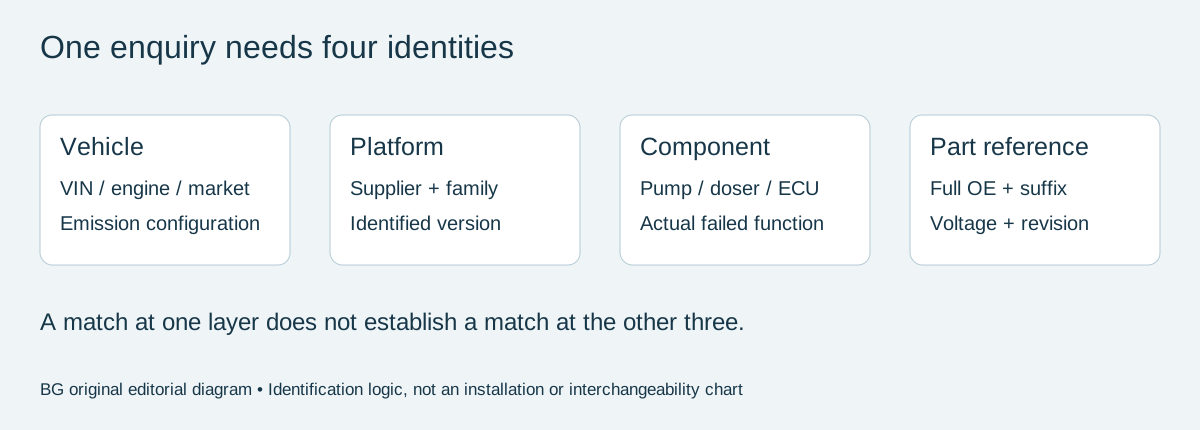
Preserve market, engine, emission configuration and the full original label. If an enquiry offers only a model name and a photograph, treat it as a candidate-identification request rather than a confirmed purchase specification.
Use the series and BG directory together
The published starting points are Denoxtronic 1/1.1, 2/2.1 and 2.2. Search BG's directory by complete part number, then send an enquiry with the component and application clearly identified.