
A practical system-level guide for workshops, parts distributors and fleet service teams working with diesel SCR dosing injectors, urea dosing valves and repair kits.
Technical summary: A DEF injector must deliver the commanded quantity as a stable, correctly directed spray without leaking after shut-down. A blocked or crystallized injector is often the visible result of a wider fault involving temperature, fluid quality, pressure control, purge strategy, mixer condition or application mismatch.
AdBlue / DEF Injector Hub
Why the DEF injector matters to the whole SCR system
Selective catalytic reduction depends on controlled delivery of diesel exhaust fluid, also known as DEF, AdBlue or aqueous urea solution. The dosing injector is the final hydraulic component before the exhaust stream. Its job is not simply to open and close: it must meter a calibrated quantity, produce the correct spray geometry, resist exhaust heat, seal after dosing and survive repeated freeze-thaw cycles.
When the injector works correctly, the water in DEF evaporates and the urea decomposes through thermolysis and hydrolysis to form ammonia. After mixing across the exhaust cross-section, ammonia is stored on the SCR catalyst and reacts with nitrogen oxides. Poor atomization, wrong direction or delayed shut-off can create local over-dosing, wall wetting, solid deposits, ammonia slip and low NOx conversion even when the total commanded DEF quantity appears reasonable.
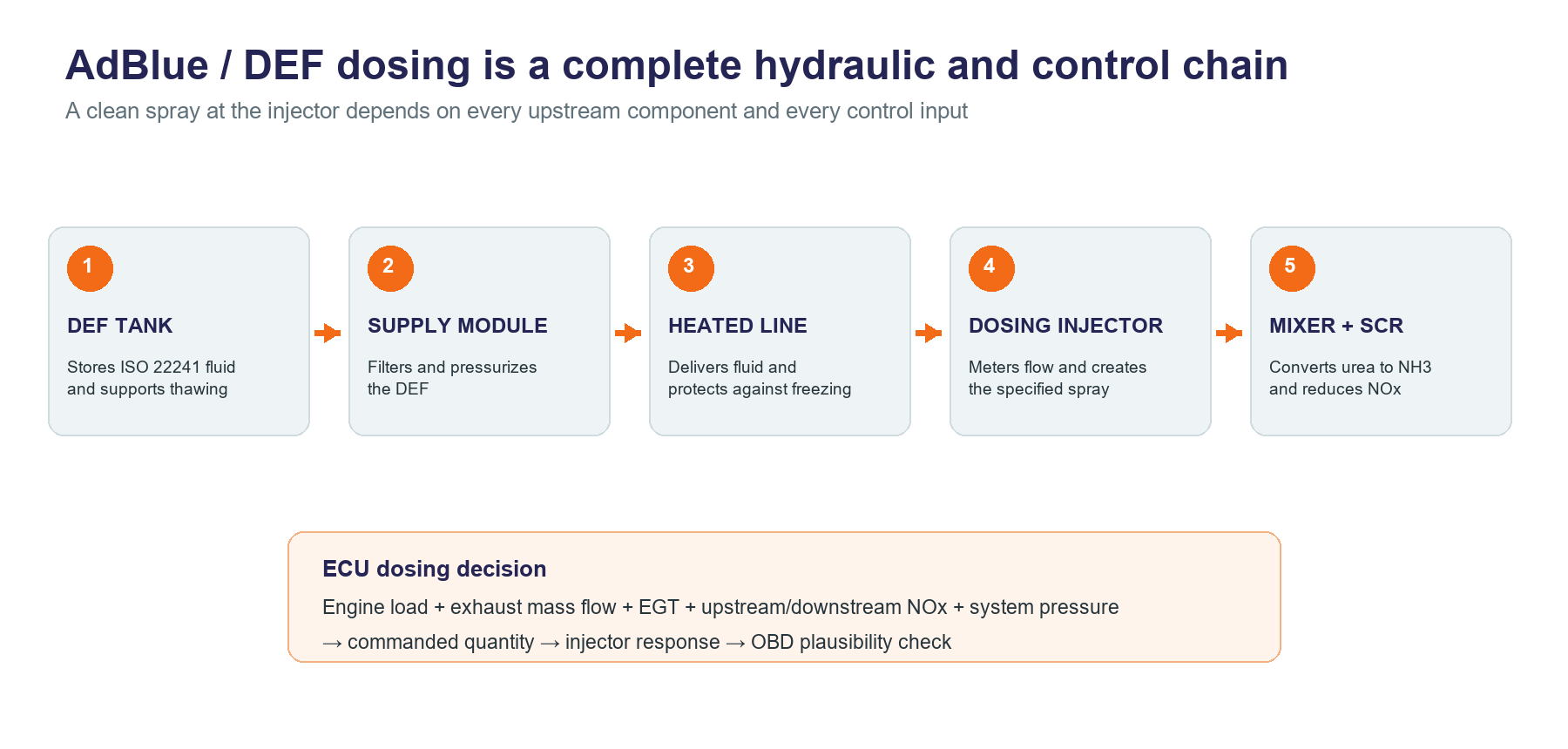
Figure 1. The DEF injector is one link in a hydraulic, thermal and electronic control chain.
Product categories: identify the injector before diagnosing it
Names vary between manufacturers. “DEF injector,” “AdBlue injector,” “urea dosing valve,” “dosing unit,” “doser” and “metering unit” may describe the component mounted on the exhaust pipe. The supply module or DEF pump is the upstream unit that filters and pressurizes the fluid. Mixing these terms can lead to ordering the wrong part or testing the wrong component.
Liquid-only DEF dosing injectors
These receive pressurized DEF from the supply module and create the spray through the injector nozzle. Variants may be cooled by engine coolant, protected by their installation position or designed for a specific underbody temperature range.
Air-assisted dosing nozzles
Some commercial, industrial and stationary SCR systems combine DEF with compressed air to improve atomization and transport. Their test method, flow specification and cleaning procedure are not interchangeable with a liquid-only vehicle injector.
Water-cooled and non-water-cooled designs
Close-coupled injectors may use coolant connections to manage high ambient temperature. Underfloor units may rely on lower installation temperature and system purge or pressure-relief strategies. Coolant fittings, seals and thermal shielding therefore belong to the diagnosis.
Application-specific spray variants
Two injectors can share a connector and mounting pattern while having different flow rates, spray angles, plume count, coil characteristics or control behavior. OE reference, supersession, engine, emission stage, installation position and software calibration must be checked together.
How an AdBlue / DEF injector works
Pressure preparation: the supply module draws filtered DEF from the tank and builds the required system pressure.
Dosing calculation: the ECU estimates the reductant requirement from engine load, exhaust mass flow, temperature, engine-out NOx and catalyst state.
Electrical actuation: the control unit energizes the injector for a calibrated pulse width or duty cycle.
Atomization: pressurized fluid passes through the nozzle and forms the specified spray pattern.
Mixing and decomposition: droplets evaporate and urea is converted to ammonia before reaching the active catalyst volume.
Closed-loop correction: NOx and temperature signals help the ECU judge conversion and modify later dosing commands.
Shut-down protection: depending on system design, pressure may be released or fluid purged to manage freezing and reduce leakage or deposit risk.
The correct operating pressure, quantity and spray shape are application-specific. A bench test should therefore use the correct test plan rather than one universal pass/fail number.
DEF injector blockage and crystallization
Fresh DEF can leave a white urea residue when water evaporates. In an operating exhaust system, however, visible white material may also contain urea decomposition products formed when droplets contact a surface that is too cold or when mixture preparation is incomplete. Deposits can build on the injector tip, mounting boss, exhaust pipe, mixer or catalyst inlet.
Common mechanisms
Low-temperature dosing: incomplete evaporation and hydrolysis increase the chance of solid deposits.
Poor spray quality: large droplets, distorted spray or an incorrect spray angle can wet the wall.
Injector leakage: fluid entering after the command ends evaporates without the intended exhaust energy and flow.
Pressure or purge faults: unstable supply pressure, restricted lines or incorrect shut-down behavior disturb metering.
Contaminated or incorrect fluid: particles can damage or obstruct dosing components; incorrect concentration changes evaporation and dosing behavior.
Damaged mixer or exhaust geometry: missing, distorted or incorrectly installed mixing hardware can create local wetting.
Wrong injector application: an apparently compatible injector may have the wrong flow or plume direction.
Biased sensor input: incorrect EGT or NOx information can cause dosing at the wrong time or quantity.
Do not diagnose by color alone. A small dry residue at a connection can indicate leakage. Heavy deposits downstream can indicate poor mixture preparation. The location, texture, operating history and test results must be considered together.
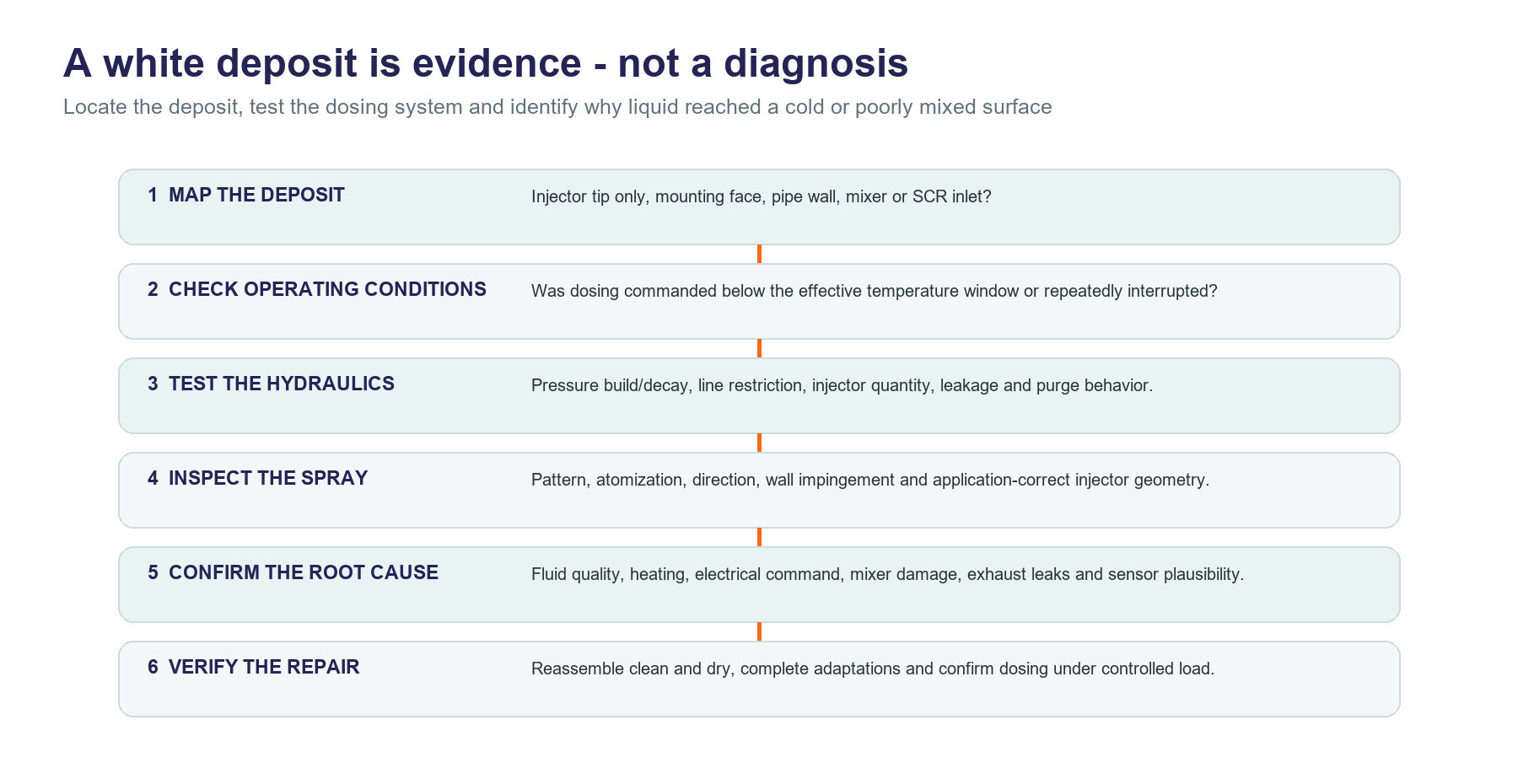
Figure 2. Treat crystallization as evidence and follow the complete dosing-system signal chain.
Testing and cleaning a DEF injector
A useful test separates electrical, hydraulic and spray-performance checks. Before removing the injector, save fault codes and freeze-frame data, inspect wiring, examine supply pressure and confirm that the temperature conditions for dosing were present.
Recommended test sequence
Visual inspection: examine connector pins, wiring, coolant fittings, mounting face, heat shield, deposit location and evidence of external leakage.
Fluid check: verify correct DEF, concentration where the service procedure requires it, cleanliness and absence of fuel, coolant, tap water or cleaning-chemical contamination.
Electrical check: use the manufacturer or tester specification for coil/electronic behavior. Do not apply uncontrolled battery voltage to an electronically controlled injector.
Pressure build and decay: confirm that the pump reaches the required pressure and that the system does not lose pressure through a leaking injector, line or valve.
Quantity test: measure delivered mass or volume over a defined command and pressure. Repeatability is as important as the average result.
Spray-pattern test: observe plume direction, atomization, asymmetry, dribble and delayed closing in a protected test enclosure.
Purge and shut-down test: confirm the system-specific pressure-release or purge behavior.
Post-repair verification: reinstall with correct seals and torque, perform required resets, and verify commanded dosing, NOx response and absence of leakage under controlled load.
Cleaning principles
Remove loose external residue without driving contamination into the nozzle or connector. Use only a cleaning method compatible with the injector materials and approved by the equipment or component supplier. Avoid metal picks, drill bits, abrasive blasting and uncontrolled ultrasonic exposure: these can enlarge or damage calibrated orifices, disturb the spray plate or force liquid into the actuator.
Cleaning is justified only when the injector passes integrity and electrical checks and the deposit is removable without altering the metering geometry. After cleaning, repeat quantity, leakage and spray-pattern tests. A visually clean nozzle that still dribbles, flows incorrectly or produces an asymmetric plume has not been repaired.
Fault pattern and proof table
Observed symptom | Possible causes | Evidence to collect | Avoid this shortcut |
|---|---|---|---|
No dosing | No pressure, electrical fault, blocked line or injector, ECU inhibit | Enable conditions, supply pressure, command signal, quantity test | Replacing the injector before confirming the pump and command |
Low or uneven quantity | Partial blockage, low pressure, contamination, internal wear | Repeated mass/volume test and pressure trace | Judging performance from one short spray event |
Dribble after command | Valve-seat contamination, damaged seal or internal wear | Leak-down and delayed-closing observation | Cleaning the tip without repeating the leakage test |
Heavy white deposits | Cold dosing, leakage, poor atomization, wrong angle, mixer fault | Deposit map, EGT history, spray test, injector part verification | Assuming every white deposit proves poor DEF quality |
Low SCR efficiency | Under-dosing, poor mixing, biased NOx sensor, catalyst aging or exhaust leak | Upstream/downstream NOx, EGT, quantity and leak tests | Replacing the catalyst before validating the dosing system |
High DEF consumption | Over-command, leak, biased sensor, incorrect injector flow | Tank usage, command data, pressure decay and quantity test | Assuming high consumption means high NOx conversion |
DEF injector replacement guide
Replace the injector when cleaning cannot restore the specified quantity and spray, when it leaks after closing, when the actuator or electronics fail, when the body or connector is heat-damaged, or when corrosion and mechanical damage make reliable sealing impossible.
Before ordering
Record the OE number and every supersession number.
Confirm vehicle or equipment model, engine code, model year and emission stage.
Identify the installation position and whether the unit is coolant-cooled, air-assisted or liquid-only.
Compare the electrical connector, hydraulic connection, coolant ports, nozzle depth and mounting geometry.
Confirm flow specification and spray angle where technical data is available.
Check the existing fault codes and correct the root cause before installing the new injector.
Installation essentials
Work cleanly; even small hard particles can damage the metering seat or nozzle.
Use new application-correct seals, clamps and mounting hardware where specified.
Clean and inspect the mounting boss and mixer without damaging coated or ceramic parts.
Route wiring, coolant and DEF lines away from heat and abrasion.
Prime, bleed, purge, reset or adapt the system only as required by the service procedure.
Complete a leak check and a monitored road or load test before return to service.
When a DEF injector repair kit is appropriate
A repair kit can be a cost-effective professional option when the component design is serviceable, the repair scope is defined and the injector body, actuator and calibrated nozzle remain within specification. Typical kits may include application-specific seals, filters, O-rings, retaining parts, connectors or other approved service items.
Use a repair kit when
The failure is traced to a serviceable seal, filter, connector or defined replaceable part.
The housing and mounting surfaces are undamaged.
The electrical actuator passes the required test.
The calibrated nozzle can pass quantity, leakage and spray-pattern testing after service.
The repair facility has the correct fixtures, cleanliness controls and final test equipment.
Replace the complete injector when
The nozzle or metering seat is worn, eroded or mechanically damaged.
The unit leaks internally after approved cleaning.
The coil, electronics or communication circuit is faulty.
The body is cracked, heavily corroded, distorted or heat-damaged.
The correct calibration, spray or flow cannot be verified.
No validated repair procedure exists for that design.
BG sourcing note: For accurate matching of an AdBlue / DEF injector or repair kit, send the OE reference, VIN or equipment model, engine code, emission stage, connector and nozzle photos, installation position and diagnostic code. Appearance alone is not sufficient for compatibility.
Frequently asked questions
Is an AdBlue injector the same as a DEF injector?
In normal aftermarket use, yes. AdBlue is a registered name used for DEF meeting the applicable quality standard. “Urea dosing injector,” “dosing valve” and “doser” are also widely used terms, but always confirm whether a catalog is referring to the exhaust-mounted injector or the upstream supply module.
Can DEF crystallization be cleaned with water?
Some fresh external urea residue is water-soluble, but that does not make water an approved internal injector-cleaning method. Water quality, electronics, materials, deposit chemistry and the calibrated nozzle must be considered. Follow the component or test-equipment procedure and retest flow, leakage and spray afterward.
Why does a cleaned injector clog again?
The root cause may remain: low-temperature dosing, contamination, incorrect supply pressure, a leaking valve, failed heating or purge behavior, damaged mixing hardware, biased sensors or an incorrect injector application.
Can I test a DEF injector with direct battery voltage?
Do not energize an unknown injector directly. Current control, pulse width and internal electronics vary. Use a compatible tester or the vehicle manufacturer’s commanded test procedure.
Does a white deposit always mean the DEF is bad?
No. Incorrect or contaminated fluid is one possibility, but leakage, cold surfaces, poor atomization, incorrect spray direction and mixing problems can produce similar evidence.
Should the injector be replaced when an SCR efficiency code is stored?
Not automatically. SCR efficiency is inferred from dosing, temperatures, NOx signals and catalyst response. Prove the hydraulic and sensor inputs before choosing the injector or catalyst as the failed part.
Build the repair around evidence
A reliable DEF injector repair starts with system pressure, temperature, electrical command and spray verification. Clean only when the component remains testable, use a repair kit only within a validated service scope, and replace the complete injector when metering integrity cannot be restored and proven.
Related BG resources: DEF / AdBlue dosing modules · DEF / urea pumps · DEF repair parts · Selective catalytic reduction guide · Common SCR system faults