
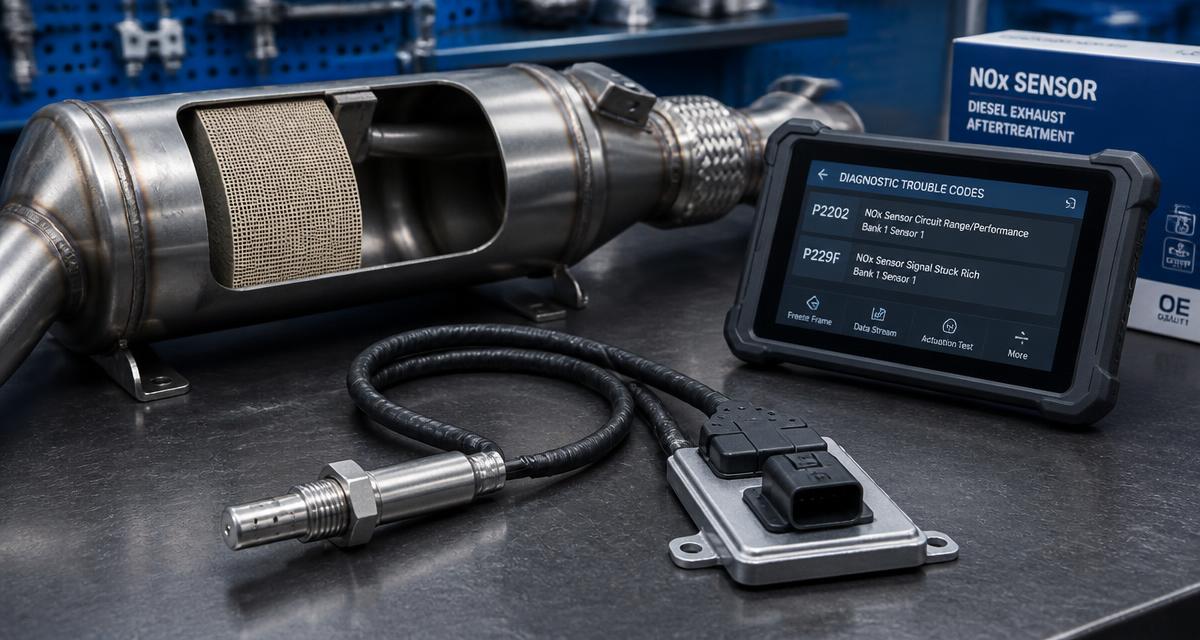
Why NOx measurement matters
Nitrogen oxides (NO and NO2, collectively NOx) form primarily when combustion occurs at high temperature in the presence of oxygen. Modern diesel engines reduce engine-out NOx through combustion management and EGR, then rely on selective catalytic reduction (SCR) to convert most of the remaining NOx into nitrogen and water.
SCR performance cannot be controlled reliably from a fixed dosing map alone. Exhaust flow, temperature, engine-out NOx, catalyst storage state, aging and duty cycle all change continuously. The nitrogen oxide sensor closes this information gap by reporting what enters or leaves the SCR system in real time.
- An upstream (inlet) NOx sensor helps establish engine-out NOx and supports feed-forward DEF/AdBlue dosing calculations.
- A downstream (outlet) NOx sensor helps evaluate NOx conversion, detect excessive tailpipe NOx, and support OBD monitoring.
- Together with EGT, oxygen, pressure and dosing-system signals, the sensors help distinguish a healthy system from a plausible fault.
KEY TAKEAWAY — A NOx sensor is not simply an emissions "sniffer." It is a heated electrochemical measurement system, a networked control input, and a critical OBD monitor. Accurate diagnosis must consider the sensor, its circuit, and the entire SCR operating environment.
Inside a NOx sensor
Most automotive NOx sensors use a heated zirconia-based electrochemical sensing element. The probe is mounted in the exhaust stream, while a nearby control module regulates the heater, processes low-level cell signals and communicates a digital result to the vehicle network. Depending on the application, the assembly may report NOx concentration together with oxygen-related data, status information and diagnostic flags.
A simplified measurement sequence:
- Exhaust gas diffuses through controlled passages into the sensing element.
- Electrochemical pumping cells manage oxygen concentration so the NOx-sensitive stage can operate predictably.
- NOx is electrochemically decomposed; the resulting oxygen-pumping current is proportional to the NOx present.
- The control electronics compensate, validate and transmit the calculated value to the ECU or aftertreatment control module.
IMPORTANT — The sensor must reach and maintain its specified operating condition before its value becomes authoritative. A cold, contaminated or electrically underpowered sensor can produce misleading readings even when the probe looks physically intact.
How the signal is used in SCR control
1. Dosing control
The controller combines NOx information with exhaust mass flow, temperature, engine operating state and catalyst models to determine the required DEF/AdBlue dose. Under-dosing leaves NOx untreated; over-dosing increases the risk of ammonia slip, deposits and system inefficiency.
2. Catalyst-efficiency monitoring
A basic conversion estimate compares upstream and downstream NOx on a mass basis. In practice, software applies filtering, delay compensation and enable conditions, because the two sensors sit at different locations and exhaust transport is not instantaneous.
3. On-board diagnostics
The control system checks electrical integrity, heater behavior, signal plausibility, response time and consistency with other system variables. A stored NOx-related DTC therefore does not automatically prove that the sensing element itself is the root cause.
What commonly goes wrong
| Failure area | What it can look like | What to verify |
|---|---|---|
| Electrical supply | No communication, heater fault, slow activation | Battery voltage, fuses, power/ground voltage drop, network integrity |
| Harness / connector | Intermittent signal after vibration or rain | Chafing, exhaust heat, pin fit, corrosion and water ingress |
| Sensing element | Bias, slow response or internal fault | Warm-up status, live-data response and circuit checks |
| Exhaust leak | Unexpected oxygen/NOx behavior | Leaks upstream of the relevant sensor, clamps and joints |
| SCR / DEF system | High downstream NOx with a functioning sensor | DEF quality/dosing, deposits, temperature and catalyst condition |
| Application mismatch | Immediate DTCs or inaccurate behavior | OE reference, position, connector, cable and calibration family |
A NOx DTC is a starting point for diagnosis, not a replacement authorization.
A disciplined NOx sensor diagnostic path
- Read DTCs and freeze-frame — preserve operating conditions before clearing evidence.
- Inspect circuit and installation — check power, ground, harness, connector, heat and water damage.
- Verify the complete aftertreatment system — check leaks, DEF quality/dosing, temperature and related signals.
- Compare warm live data — review upstream/downstream behavior during a controlled test.
- Confirm the root cause — replace only when circuit, system and plausibility checks agree.
Good diagnostics protect the new part from being used as a test tool.
Five diagnostic rules that prevent repeat failures
- Do not clear evidence too early. Record DTC status, freeze-frame data, operating hours/mileage and relevant live data first.
- Do not condemn a cold sensor. Confirm heater operation and the manufacturer's enable conditions before comparing signals.
- Do not read one channel in isolation. Interpret NOx together with EGT, oxygen, exhaust flow/load, DEF command and dosing-system status.
- Account for sensor location and transport delay. Upstream and downstream traces should not be expected to overlap instantaneously.
- Fix the environment that damaged the part. Harness routing, exhaust leaks, DEF deposits, contamination and abnormal thermal events can defeat a new sensor.
Selecting the correct replacement
Physical fit alone is not enough. NOx sensor assemblies are calibrated, networked devices, and apparently similar parts may differ in probe technology, controller software, connector coding, cable length, heater strategy and supported application. A disciplined selection process should verify:
- OE number and supersession history
- Vehicle, engine and emissions-stage application
- Upstream (inlet) or downstream (outlet) installation position
- Connector keying, cable routing and thermal protection
- Control-module communication and diagnostic compatibility
- Installation instructions, tightening method and post-installation service procedure
NOx sensor fault codes and frequently asked questions
Drivers and technicians most often reach this page after a check engine light, a failed emissions check, or a specific fault code. The examples below illustrate common patterns across passenger and commercial diesel platforms; always confirm the exact code definition and repair procedure in the applicable OEM service information.
Common NOx-related fault codes (examples)
| Code family | Typical meaning |
|---|---|
| P2201 / P2200-series | NOx sensor circuit range/performance, Bank 1 — common on North American light-duty diesels (e.g., 6.7L platforms) |
| P229E / P229F | NOx sensor circuit range/performance, Sensor 2 / Bank 2 — frequently seen on European diesel passenger vehicles |
| P2209 | NOx sensor heater control circuit malfunction |
| P20EE | SCR NOx catalyst efficiency below threshold — often triggered by an upstream sensor fault rather than the catalyst itself |
| U029D / U029E | Lost communication with the NOx sensor control module — a network/wiring fault rather than a confirmed sensing-element failure |
How much does a NOx sensor cost to replace?
Total cost depends heavily on the platform, the number of sensors required, and whether diagnosis reveals a wiring, dosing or catalyst issue rather than a sensor fault alone. Passenger-car sensors, heavy-duty truck sensors and diagnostic/labor time all vary by market and by vehicle. Rather than quoting a single price, a reliable NOx sensor supplier should provide the exact OE cross-reference for the vehicle in question so a shop or distributor can price the correct part with confidence.
Where is the NOx sensor located?
Most SCR-equipped diesel vehicles use two NOx sensors: an inlet (upstream) sensor mounted before the SCR catalyst, and an outlet (downstream) sensor mounted after it, near the tailpipe end of the aftertreatment system. Exact positioning varies by engine layout — heavy-duty trucks (Cummins, Volvo/Mack, Scania) and passenger diesels (Mercedes-Benz, BMW, Audi/VW, Ford, GM Duramax) all package the SCR section differently.
Can a NOx sensor be cleaned instead of replaced?
Some faults linked to condensation, connector corrosion or a damaged protective shield can be resolved by cleaning the connector and inspecting the harness — not the sensing tip itself. The zirconia sensing element should never be cleaned with sprays, solvents or anti-seize compounds. Once the sensing element itself shows bias, slow response or an internal fault, replacement is the appropriate repair, not cleaning.
What are the symptoms of a faulty NOx sensor?
- Illuminated check engine light with a NOx, SCR or emissions-related DTC
- Reduced power or a forced "limp"/derate mode on heavy-duty trucks
- Unusually high or low DEF/AdBlue consumption
- Failed emissions or inspection test
- Inconsistent or implausible SCR efficiency readings in scan-tool live data
What is the difference between an inlet and an outlet NOx sensor?
The inlet (upstream) NOx sensor measures engine-out NOx before the SCR catalyst and feeds the DEF dosing calculation. The outlet (downstream) NOx sensor measures tailpipe NOx after the SCR catalyst and confirms that conversion is working as expected. The two sensors are not interchangeable — each is calibrated and positioned for its specific role, and installing one in the other's position will produce inaccurate readings and diagnostic codes.
NOx sensor coverage across major diesel platforms
Because NOx sensor assemblies are application-specific, BG organizes its NOx sensor range by engine and vehicle platform rather than a single universal part. Representative platform families include:
- Cummins ISX15, ISX11.9 and ISB 6.7L (Ram 2500–5500) — inlet and outlet NOx sensors for North American heavy- and medium-duty trucks
- Mercedes-Benz Sprinter and Bluetec diesel passenger and van models — NOx sensors for OM642/OM651-family engines
- BMW and Volkswagen/Audi lean-burn and diesel platforms — NOx sensors supporting both petrol lean-NOx and TDI/SCR applications
- Volvo and Mack D11, D13 and D16 / MP7 and MP8 — inlet and outlet NOx sensors for European and North American heavy trucks
- Ford Power Stroke and GM Duramax — NOx sensors for North American light- and medium-duty diesel pickups
- Scania, DAF, Iveco and MAN — NOx sensors for European heavy-duty and construction diesel platforms
Each platform family is covered on its own product and technical page, with OE cross-reference numbers, sensor position (inlet/outlet) and common fault codes, so distributors and workshops can move directly from a vehicle or OE number to the correct part.
The BG approach: engineering reliability across the aftertreatment system
Best Growth is a specialized engineering and manufacturing partner providing diesel system solutions for the global automotive aftermarket. Within exhaust aftertreatment, the portfolio includes NOx sensors, PM sensors, EGT sensors, DEF/AdBlue injectors, urea pumps, SCR components, repair parts and testing equipment.
The value of that portfolio is not simply breadth. NOx diagnosis often crosses component boundaries: a sensor reading may expose a dosing, temperature, catalyst, wiring or application problem. BG's engineering-led approach combines OE-compatible product development, laboratory validation, standardized manufacturing and responsive technical support to help customers build reliable product categories while reducing sourcing complexity and warranty risk.
For distributors and repair professionals, this means a more useful question than "Which sensor fits?" is "Which validated solution matches the vehicle, installation position and operating system — and what evidence confirms the diagnosis?"
Conclusion
A modern SCR system can only control what it can measure. The NOx sensor supplies the feedback that turns dosing hardware and catalyst chemistry into a monitored, adaptive emissions-control system. Understanding its operating conditions, network role and interactions with the wider aftertreatment system is the foundation for accurate diagnosis and dependable replacement.
Best Growth supports global aftermarket partners with engineering-focused diesel aftertreatment solutions designed around reliable products, dependable manufacturing, validation and long-term technical cooperation.
Editorial note: Vehicle-specific diagnostic thresholds, DTC logic, torque values and service procedures must always be confirmed in the applicable OEM service information. Editorial sources reviewed: Best Growth brand positioning (internal); DieselNet technical references on engine/emission-control sensors and SCR systems; DieselNet conference reports on aftertreatment and emission sensors (2018, 2019).