
An exhaust gas temperature (EGT) sensor measures heat at one point in the exhaust stream. A probe at the diesel particulate filter (DPF) inlet reports the temperature of gas entering the filter; an outlet probe reports the temperature of gas leaving it. Neither probe measures soot loading. When regeneration stops or a temperature reading looks wrong, identify the physical probe and compare its behavior with the operating conditions before replacing it.
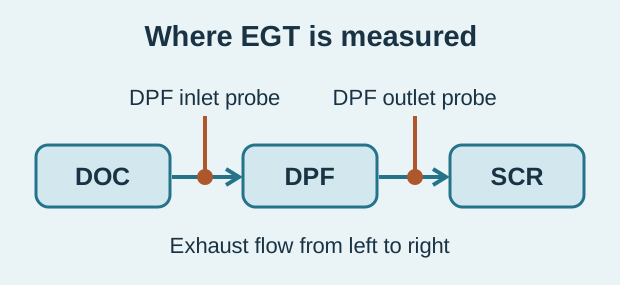
What the controller learns from each position
The diesel oxidation catalyst (DOC) can sit upstream of the DPF. In that arrangement, the DPF inlet probe can see the temperature of gas leaving the DOC, rather than the temperature entering it. DENSO describes monitoring at the DPF entry and exit to help control regeneration; Bosch illustrates multiple possible EGT locations around the aftertreatment stages. The exact control logic depends on the engine and calibration.
| Signal | What it tells you | What it cannot establish alone |
|---|---|---|
| DPF inlet temperature | Temperature of the gas reaching the filter at that probe | Whether the filter is restricted or whether the controller has met every regeneration condition |
| DPF outlet temperature | Temperature of the gas leaving the filter at that probe | A universal inlet-to-outlet difference that proves a healthy filter |
| DPF differential pressure | Pressure drop across the filter when the measurement path is intact | Exhaust temperature or the cause of a restriction |
Temperature differences depend on the operating phase and the thermal response of the assembly. Compare synchronized readings through warm-up or a manufacturer-approved test instead of assuming the outlet must always be hotter or colder.
Check the signal before replacing the probe
- Map the channel to the vehicle. Save the exact fault and freeze-frame data. Use the engine-specific wiring diagram and component location guide to map the scan-tool label to a physical connector. “Sensor 2” does not identify the same location across all platforms.
- Look for an implausible pattern. After a suitable cold soak, compare the temperature channels against one another and against a reliable ambient reference within OEM tolerances. A persistent outlier or fixed value suggests a channel worth testing. A cold comparison cannot rule out a heat-related intermittent fault.
- Separate the circuit from the thermal problem. Inspect routing, connector condition and heat or vibration damage. Follow the manufacturer’s circuit test and specified resistance–temperature data where applicable. If the readings are plausible but the system fails to warm as expected, check the manufacturer’s regeneration enable criteria and heating strategy before blaming the probe.
- Match the replacement by position and part number. Confirm the current OE reference against engine or vehicle identity and installation location. Similar connectors or threads do not establish the same sensing curve, insertion depth or lead routing.
HELLA describes both positive and negative temperature coefficient thermistors: their resistance moves in opposite directions as they heat. Its published example shows a fixed low scan reading associated with a possible circuit interruption or sensor fault; that example is not a universal open-circuit value.
Frequently asked questions
Can a bad EGT signal stop a DPF regeneration?
It can affect temperature control. The response depends on the platform and fault: the controller may substitute a value, restrict operation or withhold a regeneration routine. Read the OEM fault logic and inhibit reason for the application.
Is an EGT sensor the same as a DPF pressure or PM sensor?
No. An EGT sensor measures temperature. A DPF differential pressure sensor measures the pressure drop across the filter. A downstream particulate matter (PM) sensor helps monitor filtration performance by detecting particles. These measurements answer different diagnostic questions.
BG catalogue and related reading
- BG exhaust gas temperature sensor catalogue — use the OE number and confirmed sensor position to narrow the search. This is a category link, not an application match.
- BG guide to DPF regeneration — explains passive, active and service regeneration.
Sources
- DENSO: Exhaust Gas Temperature Sensors — DPF entry and exit monitoring.
- HELLA Tech World: Checking the exhaust gas temperature sensor — sensing principles, circuit diagnosis and a vehicle-specific example.
- Bosch Aftermarket: Exhaust-gas treatment poster — an example of sensor placement across aftertreatment stages.
Sources checked: 18 November 2026.